
VDA 5050: the communication standard for AGV and AMR fleets
VDA 5050 is the standardized interface between master control and mobile robots from different manufacturers. This guide explains what the standard covers, how it works technically, and what it means for operators, integrators and vehicle manufacturers – including its relationship to LIF and an FAQ.
What is VDA 5050?
Definition, origin and purpose of the standardized interface between master control and vehicles.
Why was it created?
The vendor lock-in problem in heterogeneous fleets and how an open standard addresses it.
How does it work technically?
MQTT-based topics for order, state, visualization and factsheet – an overview.
VDA 5050 vs. LIF
Two complementary standards: runtime communication and layout exchange.
What is VDA 5050?
VDA 5050 is a standardized communication interface between a higher-level master control – often called a fleet manager – and automated guided vehicles (AGVs) as well as autonomous mobile robots (AMRs). The standard specifies the format in which orders are handed to vehicles, how vehicles report their status back, and how position and connection data are transmitted.
VDA 5050 was developed jointly by the German Association of the Automotive Industry (VDA) and the German Mechanical Engineering Industry Association (VDMA). Its origin lies in automotive manufacturing, where plants typically operate vehicles from several manufacturers at once and, before the standard existed, had to implement an individual proprietary interface for every combination of master control and vehicle type. Since then, the standard has become established across industries and is now used in general intralogistics, manufacturing and distribution.
An important distinction: VDA 5050 describes how master control and vehicle talk to each other – not what master control decides internally. Traffic management, order optimization and route planning remain the responsibility of the respective fleet management system. VDA 5050 only standardizes the message format at the outward-facing interface.
The name reflects its origin: "VDA" stands for the German Association of the Automotive Industry, and "5050" is the sequential number within the VDA recommendation series. Although the standard was originally conceived for automotive plants, it is now written in industry-neutral terms and is used well beyond automotive – in general intralogistics, food production, e-commerce fulfillment and machine building.
Why was VDA 5050 created?
Before VDA 5050, virtually every AGV/AMR manufacturer communicated with master control through its own proprietary interface. For operators, this meant that once vehicles from one manufacturer were integrated, they were effectively locked into that vendor. Switching, or adding vehicles from a second manufacturer, typically required an entirely new, costly integration effort – on both sides, master control and vehicle.
This vendor lock-in problem grows more expensive as fleets become larger and more heterogeneous. Many plants and warehouses today no longer rely on a single AGV/AMR supplier; instead they combine vehicles from different manufacturers depending on the use case – heavy-duty tuggers from one vendor alongside lightweight picking AMRs from another, for instance. Without a shared communication standard, integration effort grows with every new vehicle class added.
There is also a business argument: individual interfaces need to be re-aligned and re-tested on both sides with every software update. If a vehicle manufacturer changes its proprietary protocol, master control has to follow suit – and vice versa. That ties up development capacity that should be going toward functionality rather than interface maintenance. An open, versioned standard with broad market adoption structurally reduces this maintenance burden.
VDA 5050 solves the problem by defining a uniform, open interface that any conformant vehicle can implement. A master control system that speaks VDA 5050 can, in principle, address vehicles from different manufacturers without building a separate integration for each one. That lowers integration cost, shortens project timelines, and gives operators real freedom of choice when procuring vehicles – a factor that increasingly shows up as a requirement in tenders and specifications.
How does VDA 5050 work technically?
VDA 5050 relies on MQTT as its transport protocol. MQTT is a lightweight publish-subscribe protocol well suited to many simultaneously connected devices with limited bandwidth – a good fit for fleets with numerous vehicles continuously sending status data. Each vehicle gets its own MQTT topic namespace, typically structured by manufacturer, vehicle type and serial number.
Within that namespace, VDA 5050 defines several message types (topics), each transmitted as a JSON message. The most important ones are listed below. Together they form a complete communication cycle: master control sends orders, the vehicle confirms progress and status, and both sides reliably detect when a connection drops.
An order typically consists of a sequence of nodes and edges describing the planned path, along with optional actions at individual nodes – such as "lift", "dock" or "open a flap". The vehicle works through this sequence and continuously reports back via state which node it last reached, which actions are complete, and whether any errors or warnings are present. This interplay of order and feedback is the core of the standard.
Another important building block is error handling. VDA 5050 defines structured error and warning messages with severity, error type and affected action, allowing master control to react automatically – for example by computing an alternative order or alerting an operator. It also specifies how a vehicle can pause, resume or cancel its current order without the communication between master control and vehicle becoming inconsistent. These details may look minor at first glance, but in practice they often determine how robust an integration is when something goes wrong.
Order data: target nodes, edges, actions. Master control tells the vehicle which path to drive and which actions to execute at which stations.
Status reports: position, battery, current order progress, errors and warnings. The vehicle continuously reports its state.
High-frequency position and speed data, separate from state, for smooth live rendering in dashboards and monitoring interfaces.
Connection status (online, offline, connectionbroken) via MQTT Last Will and Testament, so master control reliably detects outages.
Static vehicle properties: type class, dimensions, supported actions, load profiles. Sent rarely, usually only on registration.
Actions to execute immediately outside the regular order, such as horn, e-stop acknowledgment or manual pause.
Versions and ongoing development
VDA 5050 is continuously developed by a working group of VDA, VDMA and industry partners. Since its first release, the standard has gone through several version updates that expanded, among other things, the scope of actions, error handling and factsheet data. Because details can change between versions, it is worth checking the current published specification from the VDA working group before any integration, and confirming which version master control and vehicle manufacturer each support.
In practice, this means VDA 5050 conformance is not a binary statement. Two systems both marketed as "VDA 5050 compliant" do not necessarily support the same version or the same functional scope. In tenders and integration projects, it is therefore worth clarifying the specific version supported and the extent of implemented topics and actions.
Earlier versions of the standard focused more narrowly on basic driving and status functions; later updates expanded error handling, the structure of factsheet data, and flexibility around actions. This incremental expansion is typical of an actively maintained industry standard: backward compatibility is a goal but is not guaranteed in every case. Anyone planning an integration should check the release notes of the current specification rather than relying solely on older documentation or vendor claims.
What VDA 5050 means for different roles
Operators / logistics teams
Can orchestrate vehicles from multiple manufacturers under one master control without being technically tied to a single vendor. VDA 5050 is increasingly a tender requirement.
System integrators
Significantly reduce integration effort per vehicle type by implementing a standardized interface instead of proprietary point-to-point connections.
Vehicle OEMs
Access more projects once their vehicles are VDA 5050 compliant, since operators and integrators actively look for standard conformance.
Typical use cases in practice
A classic scenario is extending an existing AGV fleet with vehicles from a second manufacturer – for example because the original supplier does not offer a suitable vehicle class for a new application. If both vehicle types support VDA 5050, the existing master control can, in principle, address the new vehicles through the same interface instead of building a second, parallel integration.
Another use case involves system integrators delivering projects for multiple end customers with different vehicle preferences. Rather than building a new proprietary connection for every project, they implement VDA 5050 once in their master control software and reuse that investment across many projects, regardless of which vehicle manufacturer is used in any given deployment.
VDA 5050 conformance also increasingly shows up as an explicit award criterion in tenders from public authorities and large private buyers. Buyers use it to protect against future vendor lock-in and to keep the option open to add vehicles from further suppliers later, without jeopardizing existing investment in master control.
Common misconceptions
A common misconception is that VDA 5050 is itself a fleet management system or a piece of software you could "buy". In reality, VDA 5050 is only a specification – a document that defines message formats. The actual software implementing that specification comes from fleet management providers and vehicle manufacturers. VDA 5050 itself ships neither a reference implementation nor a runtime environment.
A second misconception concerns the scope of standardization: VDA 5050 governs communication between master control and vehicle, not communication between master control and upstream systems like ERP or WMS, and not the internal logic of vehicle control itself – such as obstacle avoidance or localization. Those areas remain manufacturer-specific and are outside the scope of the standard.
Third, VDA 5050 is sometimes equated with full interoperability – in the sense of "any VDA 5050 vehicle automatically works with any VDA 5050 master control". That is broadly true but should be understood with a caveat: version, supported functional scope, manufacturer-specific extensions to factsheet data, and the quality of the respective implementation all affect how smoothly a concrete integration actually goes. A compatibility test within the specific project remains worthwhile.
VDA 5050 and LIF: complementary standards
VDA 5050 and LIF (Layout Interchange Format) are often mentioned in the same breath, but they govern different things. VDA 5050 is the runtime standard: it defines how master control and vehicle communicate during live operation – orders, status, position. LIF is the layout standard: it defines how a driving environment – nodes, edges, stations, traffic rules – is exchanged as a structured file between a planning tool and fleet management.
In practice, the two standards work together: a layout is first planned and exported as LIF, then imported into master control. Once vehicles are in live operation, they communicate with that master control over VDA 5050, based on the previously imported layout. LIF brings the plan into operation; VDA 5050 keeps operation running.
For project teams, this separation is useful because it cleanly divides two different integration tasks. "How do we describe our driving environment consistently?" is answered by LIF. "How do our vehicles talk to master control?" is answered by VDA 5050. Together, both answers form a vendor-independent picture – from the first layout sketch to live fleet operation.
How FleetEngine supports VDA 5050
FleetEngine is a planning, simulation and visualization platform for AMR/AGV fleets – not a fleet management system and not a master control. FleetEngine does not control vehicles over VDA 5050. Instead, it supports the standard at two points along the planning cycle:
This separation is deliberate: teams that need a solid planning foundation for a VDA 5050 project – vehicle count, layout variants, throughput validation – find it in FleetEngine, without having to stand up an additional control system. Actual vehicle control over VDA 5050 remains the responsibility of the respective fleet management system, with which FleetEngine collaborates via layout data and telemetry.
For teams that want to represent both layout planning and operational monitoring in one consistent model, this creates an end-to-end flow: Editor and Simulation deliver the validated layout and expected fleet size, the fleet management system takes over operation and control via VDA 5050, and Visualization shows real telemetry back in the same planning context – enabling continuous learning between planning and operation.
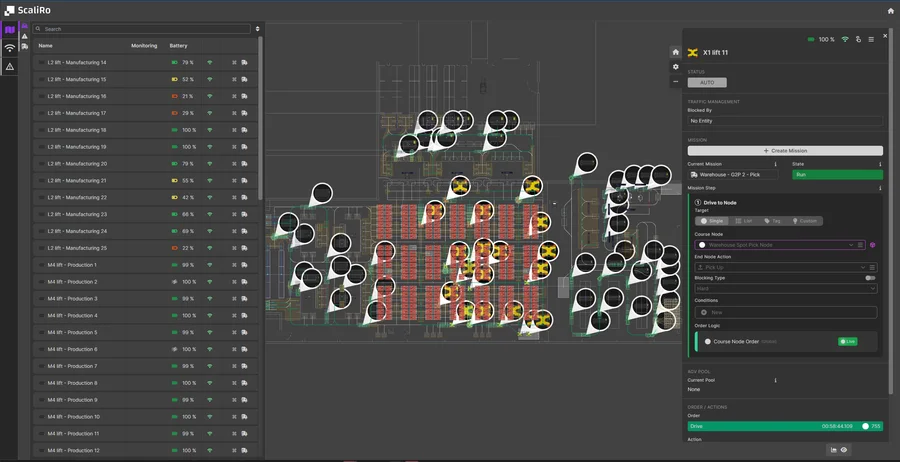
Simulating VDA 5050 compliant fleets
Already during planning, you can simulate vehicle behavior that matches VDA 5050 message structures and order logic – validating layouts and fleet sizes before a single vehicle is ordered.
Visualizing VDA 5050 telemetry
Real status data from live operation, received via VDA 5050, can be shown in the same environment as the original planning model – plan and reality side by side, without FleetEngine controlling any vehicle itself.
Official Resources
For the authoritative specification text, JSON schemas and version history, the official sources from VDA and the VDA5050 working group are the right place to look:
FAQ on VDA 5050
Is VDA 5050 mandatory for AGV/AMR projects?
Which manufacturers support VDA 5050?
What is the difference between VDA 5050 and LIF?
Do I need VDA 5050 already during the planning phase?
What technology does VDA 5050 rely on?
Does VDA 5050 replace my fleet management system (FMS)?
VDA 5050 in practice
In-depth articles on the individual questions that keep coming up in projects.
Mixed AMR Fleet: Interoperability Is Not a Traffic Plan
VDA 5050 interoperability became a selling point in 2026. What it solves in a mixed fleet, where the bottleneck moves, and what that means for procurement.
VDA 5050: Does the robot still need a map of its own?
VDA 5050 was meant to make the map on the robot obsolete. Why it stayed in nearly every project, what it costs, and since when the standard governs it.
Plan and visualize VDA 5050 fleets
FleetEngine supports VDA 5050 during the planning and visualization phase: design layouts, simulate vehicle behavior, and view real telemetry alongside your plan.