
LIF – Layout Interchange Format: the standardized language for AGV/AMR layouts
LIF is an open, vendor-neutral data exchange standard used to transfer layout data for automated guided vehicles - paths, nodes, and stations - between planning tools and fleet management systems. This guide explains what LIF contains, who needs it, and how it relates to VDA 5050.
What is LIF?
LIF stands for Layout Interchange Format, an open data standard for exchanging layout information for automated guided vehicles (AGVs) and autonomous mobile robots (AMRs). It was developed in the VDMA environment - the same trade-body context that produced VDA 5050 - and defines how a physical layout is translated into a machine-readable, vendor-neutral structure.
Concretely, LIF defines a graph-based representation of the drivable area: nodes as positions, edges as the connections between them, and stations as points where vehicles execute orders. This structure is independent of the fleet management system or vehicle vendor in use - a LIF layout can, in principle, be imported by any compatible system regardless of which tool created it.
Technically, LIF is a structured, text-based file format that can be versioned with standard tooling, stored in Git repositories, and validated in automated checks - unlike proprietary binary formats that are often tied to a single vendor's tool. That openness is not incidental; it's a core design goal. A layout should be reviewable, versionable, and traceable across tool boundaries, the same way exchange formats have long worked in other engineering disciplines - AutomationML in plant engineering, or IFC in building construction.
It's worth distinguishing LIF from "layout" in the everyday sense: LIF is not a replacement for the CAD drawing of a facility, but a derived view specialized for vehicle routing. Walls, racks, and other structural elements matter to LIF only insofar as they bound the drivable area - the actual payload of the format is nodes, edges, and stations as the basis for routing and traffic logic inside the fleet manager.
The problem LIF solves
Before LIF, virtually every fleet management system vendor used its own proprietary layout format. A layout built for one system could not simply be carried over to another. Whenever an operator switched FMS vendors, expanded their warehouse with a second fleet, or worked with multiple integrators at once, the layout typically had to be redrawn from scratch.
That created duplicated work, higher risk of error during manual re-entry, and effectively a form of vendor lock-in: once a layout was invested in a proprietary format, switching to another system meant absorbing the cost of rebuilding it.
LIF addresses exactly that friction. Instead of maintaining a separate representation per target system, the layout is created once in a standardized format and can be read by any LIF-compatible system. That reduces integration overhead, turns layout data into an independent, portable asset, and creates the foundation for real vendor competition based on open interfaces rather than proprietary formats.
The economic effect is not just theoretical. In multi-vendor projects - an operator running vehicles from multiple manufacturers in the same warehouse, or an integrator planning the same facility for several customers on different fleet management systems - the cost of redundant layout creation quickly adds up to several person-days per project. Every manual transfer of a layout from one format to another is also a potential source of error: miscopied coordinates, missed stations, or mismatched vehicle footprints can, in the worst case, only surface as collisions or blocked traffic during commissioning.
What a LIF file contains
At a high level, LIF describes a layout as a graph of nodes and edges, plus stations and metadata.
Nodes
Positions in the layout - waypoints, junctions, or holding positions - each with a unique ID and coordinates.
Edges
Connections between nodes describing drivable paths, including direction, length, and any speed limits.
Stations
Pickup, drop-off, or charging points, and other locations where vehicles execute orders.
Metadata
Layout name, version, author, and coordinate system - keeping multiple planning revisions traceable.
The exact field catalog is defined in the official LIF specification and evolves under the standardization group. This overview describes the conceptual structure, not the full schema.
{
  "metaInformation": {
    "projectIdentification": "Warehouse-Rosenheim-Hall3",
    "creator": "FleetEngine Editor",
    "exportTimestamp": "2026-07-15T09:30:00Z",
    "lifVersion": "1.0.0"
  },
  "layouts": [
    {
      "layoutId": "layout-hall3-v3",
      "layoutName": "Hall 3 – Picking Area",
      "layoutVersion": "3",
      "nodes": [
        {
          "nodeId": "N-104",
          "nodeName": "Waypoint Rack Aisle 4",
          "nodePosition": { "x": 12450, "y": 8300, "mapId": "map-hall3" }
        },
        {
          "nodeId": "N-105",
          "nodeName": "Charging Station Handoff",
          "nodePosition": { "x": 13100, "y": 8300, "mapId": "map-hall3" }
        }
      ],
      "edges": [
        {
          "edgeId": "E-104-105",
          "startNodeId": "N-104",
          "endNodeId": "N-105",
          "maxSpeed": 1.2
        }
      ],
      "stations": [
        {
          "stationId": "ST-CHARGE-02",
          "stationName": "Charging Station 2",
          "stationPositions": [{ "nodeId": "N-105" }]
        }
      ]
    }
  ]
}
Simplified LIF example: metadata, one layout with two nodes, one edge, and one charging station.
Who needs LIF
LIF matters to anyone who needs to move layout data between planning and operations - or between multiple systems.
Planners and layout designers
Build the layout once and export it in a standardized format instead of maintaining a separate one for every target system.
System integrators
Hand off validated layouts to the customer's fleet management system without manual rework or format conversion.
FMS vendors
Import customer layouts through one standardized interface instead of building a custom adapter per planning partner.
Warehouse operators
Keep layout data as an independent, vendor-neutral asset, regardless of which FMS or vehicles are in use.
LIF across the project lifecycle
In practice, LIF shows up at several points in an AMR/AGV project, not just at the end. In the early planning phase, the layout serves as the basis for feasibility studies and throughput simulations - well before a contract with an FMS vendor is even signed. Once layout variants stabilize, the chosen layout is exported as a LIF file and handed to the system integrator or FMS vendor, who imports it into their fleet management system.
During commissioning, the LIF file serves as a shared reference between the planning team and the integrator: if real vehicle behavior diverges from the planned routing, the layout data makes it quick to check whether the cause lies in the layout itself or elsewhere in the system. In ongoing operations, the layout is updated whenever the facility changes - new racking, altered traffic flow, additional stations - and re-exported as LIF, rather than patching the change locally in the FMS and letting the planning baseline go stale.
This recurring export-import cycle is the real value of LIF: it turns the layout into a living, versioned asset that stays consistent across the entire project lifetime - from the first feasibility study to an expansion years later - instead of being reinterpreted at every step.
LIF and VDA 5050: complementary, not competing
Both standards solve different problems along the same project lifecycle - from planning to operations.
LIF - static layout exchange
- • Describes the layout: nodes, edges, stations
- • Exchanged during planning or whenever the layout changes
- • Vendor-neutral, file-based handoff
- • Basis for routing inside the fleet manager
VDA 5050 - runtime communication
- • Describes orders, states, telemetry
- • Runs continuously during operations
- • Message-based interface (typically MQTT)
- • Communication between FMS and vehicle
In practice, the two standards complement each other: the LIF layout defines where a vehicle can drive. VDA 5050 carries what it is doing right now. Projects that use both standards achieve end-to-end interoperability from planning through operations.
How FleetEngine uses LIF
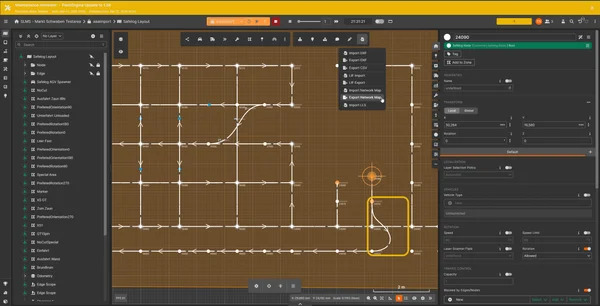
The FleetEngine Editor is a visual planning environment for AMR/AGV layouts: paths, nodes, stations, traffic zones, and vehicle footprints are designed on screen instead of maintained in CAD drawings or spreadsheets. The result is exported as a standard-compliant LIF file, ready to load directly into compatible fleet management systems.
FleetEngine Simulation also works from LIF layouts: the same layout prepared for export serves as the basis for throughput, utilization, and bottleneck analysis - planning and simulation share the same data foundation instead of maintaining separate models.
ScaliRo is an early adopter of the LIF standard. Together with customers such as ARTI Robots, LIF was put into production use early on as a new industry standard - according to a public customer quote from ARTI CEO Konstantin Mautner-Lassnig, ScaliRo's FleetEngine and ARTI's vehicle expertise allowed the company to quickly implement new industry standards like LIF and VDA 5050 as market pioneers together with ScaliRo.
The difference from a plain drawing shows up most clearly during validation: on export, FleetEngine checks whether the layout forms a coherent, drivable structure - for example, whether stations are actually reachable via edges, and whether vehicle footprints collide with infrastructure anywhere along a route. Errors that would otherwise only surface during commissioning of a static CAD drawing become visible during the planning phase instead, before the layout is even exported.
LIF and VDA 5050 work together here: LIF provides the layout for export, and VDA 5050 then carries the runtime communication between fleet manager and vehicles. FleetEngine covers both sides of that handoff.
Conclusion: LIF as the foundation for portable layouts
LIF solves a specific but costly problem: binding layout data to a single fleet management system. Teams that plan, export, and maintain layouts as LIF retain control over a central asset of their automation project, regardless of which FMS is in use today or gets adopted in the future.
For teams planning AMR/AGV projects, the practical starting point is usually not the specification document itself, but a tool that offers LIF as a native export format - eliminating manual format work and making the standard part of the normal planning workflow rather than an extra step at the end of a project.
In tenders and requirement specifications in particular, it pays to look explicitly at the LIF capability of the systems involved: when LIF export and import are stated as a requirement rather than implicitly assumed, the actual interoperability between planning tool, integrator, and fleet management can be verified before the project starts - not only after the layout has already been transferred by hand several times.
FAQ
What is the difference between LIF and VDA 5050?
Who developed and published LIF?
Which tools support LIF?
How do I create a LIF layout?
Is LIF an official, mandatory standard?
Can I convert an existing CAD layout to LIF?
Official Resources
LIF is published and maintained by the VDMA (German Mechanical Engineering Industry Association), Materials Handling and Intralogistics Association, as a companion standard to VDA 5050. The official sources below are the binding technical reference:
- VDMA: Mobile Robots – Layout Interchange Format
The VDMA's official overview page for the LIF standard.
- VDMA guideline: LIF – Layout Interchange Format (PDF)
The technical guideline document with the full field catalog.
- VDA5050 organization on GitHub
The official repository for the VDA 5050 specification, out of which LIF emerged as a companion standard.
LIF in practice
In-depth posts on the questions that keep coming up in projects.
Export LIF layouts straight from the editor
FleetEngine creates, validates, and exports your AMR/AGV layouts as LIF - ready for your fleet management system.