In 2026 interoperability moved from a standards topic to a selling point. For a good year now, manufacturers of mobile robots have been announcing VDA 5050 adapters and certifications so their machines can run under third-party master control. For operators that is good news, because it lowers the barrier to a second manufacturer considerably. It also invites a misreading: that a mixed fleet is thereby solved. It is not. Interoperability solves the connection question. The traffic question stays wide open. This post shows where that line runs and what follows for procurement. The protocol basics are in our guide to VDA 5050.
What actually happened
What tells the story is not how many announcements there were but which way they point. In March 2025 one manufacturer released its own VDA 5050 adapter, a piece of software that makes its robots connectable to third-party master control. In April 2026 another went public with certifications of its robots against three VDA 5050 capable master control systems.
The distance between those two steps is the point. An adapter says a connection is possible. Certification against several master control systems says the connection has been tested, against named counterparts. That is no longer a statement of intent, it is something a sales team can put in a quote. Connecting a second robot type has stopped being an integration project and become a configuration.
This is exactly the development we have wanted for years as a vendor-independent supplier. What it does, though, is move the bottleneck rather than remove it.
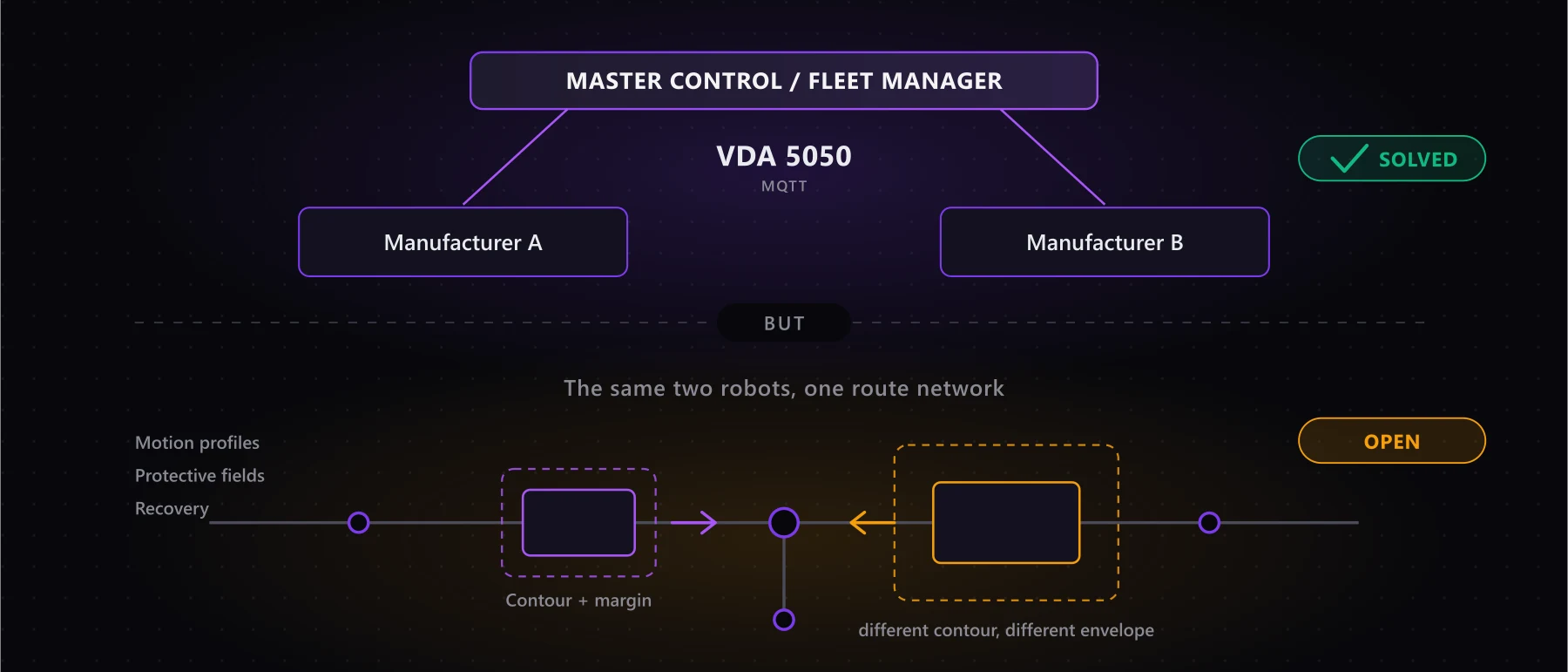
In short: VDA 5050 makes sure two robots speak the same language. Whether they behave sensibly in the same aisle is a different question, and no protocol answers it.
What the protocol solves, and what it does not
VDA 5050 governs how a master control sends an order as a sequence of nodes and edges, and how the robot reports its state back. That is the connection layer, and the standard is strong there.
What it does not govern is how the robots physically behave towards each other. That is precisely where two manufacturers differ most:
- Contours. Every robot occupies a different footprint. A robot carrying an overhanging load occupies a different one again, depending on what it is carrying.
- Motion profiles. Acceleration, braking behaviour and cornering speed are manufacturer-specific. Two robots that both show “1.5 m/s” on the data sheet clear an intersection at different rates.
- Protective fields. Size and switching behaviour sit on the robot and stay there. A robot that triggers earlier blocks its neighbour more often.
- Recovery. How a robot finds its way back into an order after a fault is only half covered by the standard.
In our simulations traffic is not a parameter, it is a result. Blocking emerges from the real contours, and intersections are governed by traffic management zones. We work with the robot’s own outline plus a margin of roughly 10 to 20 centimetres, projected forward onto nodes and edges like an envelope. Overhanging loads enlarge that envelope further.
Which is the point: those values differ per manufacturer. A mixed fleet is therefore not the sum of two fleets, it is a traffic system of its own.
The bottleneck moves into commissioning
When the connection gets easier, the hardest part becomes more visible. The supplier side says so openly: an outdated warehouse management system and a lack of real-time data make it difficult to install a fully automated material handling system on your own. That matches what integrators tell us: the effort rarely sits in the protocol.
None of this is new. It simply stands out more now that the protocol hurdle is lower. Adding a second manufacturer today means buying more than mobile robots; it means buying a second rule set, with its own map world, format and update path. How many map worlds that creates, and who keeps them apart, we covered in Does the robot still need its own map?
What can be settled before the contract is awarded
The decisive question is not whether both manufacturers speak VDA 5050. It is whether this layout carries this mixed fleet at peak load.
That can be checked before a single robot is ordered, using the real contours and motion profiles of both manufacturers on the real layout. Three things matter more than they are usually given credit for:
- Run it long enough. A single simulated day hides effects that build slowly. Typical runs cover several days up to a full week at a sustained 110 to 120 percent load. Battery states carry over from day to day, and a charging concept that survives one day can drift into deficit by the third.
- Model the differences for real. Simulating two robot types with identical default values does not answer the question you meant to ask.
- Test the coupling instead of assuming it. The link between master control and robot runs in both directions: an external master control sends orders to simulated robots, or simulated orders run against real robots. Mixed setups also work, with an external fleet manager, simulated and real robots in one plant.
Our simulation is graph-based: nodes, edges, corridors and zones as LIF and VDA 5050 describe them, not the robot’s internal path planning. For structured intralogistics that is the right modelling depth. Dispatching in live operation remains the job of fleet management: we complement it, we do not replace it.
Conclusion: the standard is the precondition, not the answer
- The move from adapters to certification against named master control systems is real and it helps. It lowers the barrier to a second manufacturer from an integration project to a configuration.
- What it settles is the connection. Contours, motion profiles, protective fields and recovery stay manufacturer-specific, and they meet for the first time in your building.
- A mixed fleet is not the sum of two fleets. It is a traffic system of its own, with its own behaviour.
- The bottleneck has not disappeared. It has moved into commissioning, where it costs more.
- All of it is testable beforehand, in simulation, with real contours, over several days and at peak load.
Are you extending an existing fleet with a second manufacturer, or planning mixed from the start? In a free initial call we work out which of these questions are still open for your layout. Get in touch.

About the author
Tim Nowak
Tim Nowak is co-founder and Managing Director of ScaliRo GmbH. He supports operators, manufacturers and integrators with vendor-independent planning and simulation of mobile robot fleets.
LinkedIn