Humanoid robots are everywhere in 2026, on trade show floors and in social feeds alike. Several vendors are developing them specifically for warehousing and logistics. If you are planning a mobile robot fleet right now, a new question comes up fast: should we wait for humanoids instead?
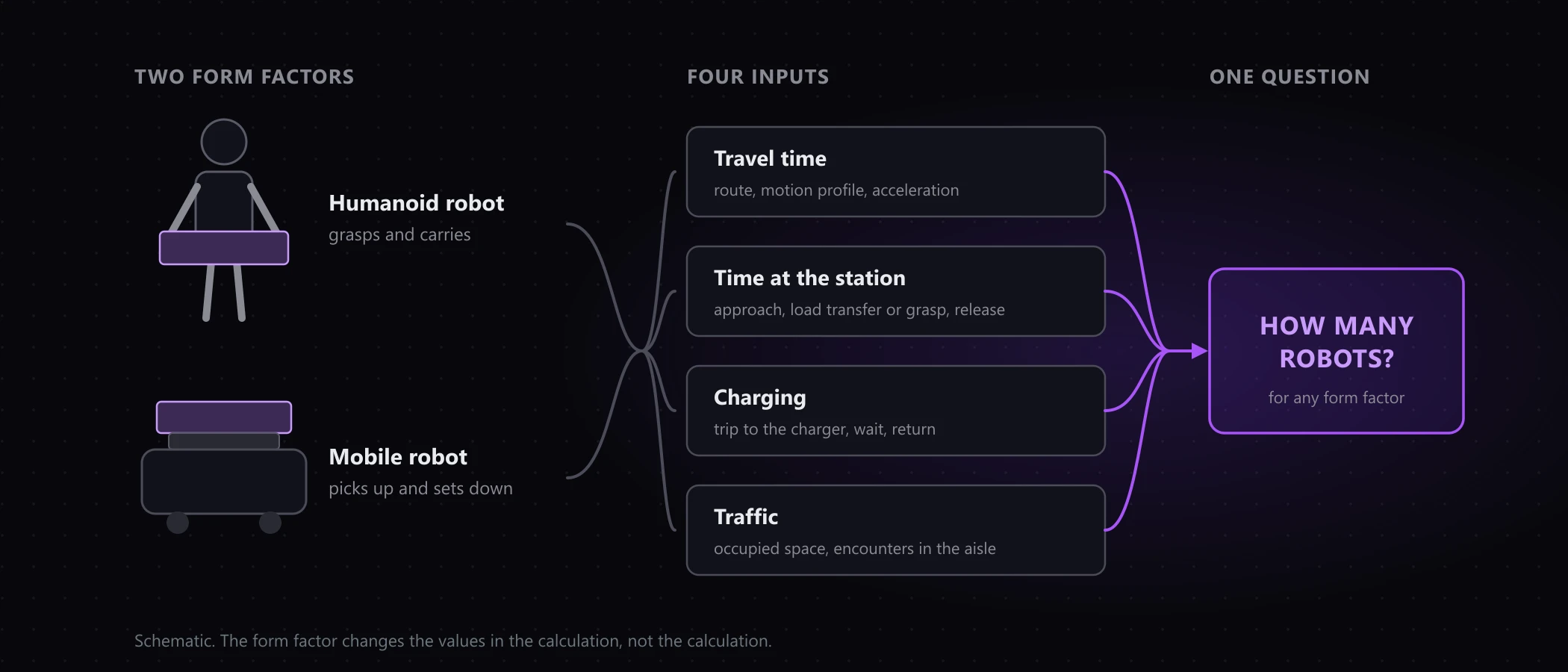
The answer is more sober than the videos. Whether a robot has two legs or four wheels changes the values in the calculation, but not the calculation itself. How many robots you need is decided the same way for humanoid robots as for AMRs, and by the same four inputs.
In short: Fleet size is decided by travel time, station time, charging and traffic, not by the shape of the robot.
What is a humanoid robot in intralogistics?
A humanoid robot is a mobile robot with a human-like build: a torso, two arms, and either legs or a wheeled base. It is designed for environments built for people. In a warehouse, it is meant to grasp and carry totes and cartons where people work today, without the stations having to be rebuilt.
The real difference from a mobile robot is the hand. A mobile robot does not grasp. It picks up and sets down, using a fork, a roller conveyor or a lift table. A humanoid robot grasps. It combines transport and grasping in one body, and that shifts where the time goes at a station.
Four inputs that decide every fleet
For fleet sizing, the form factor is one input among many. The calculation itself rests on four inputs, and none of them disappears because a robot has legs:
- Travel time. Route length, motion profile, acceleration and braking. A different motion profile only changes the number.
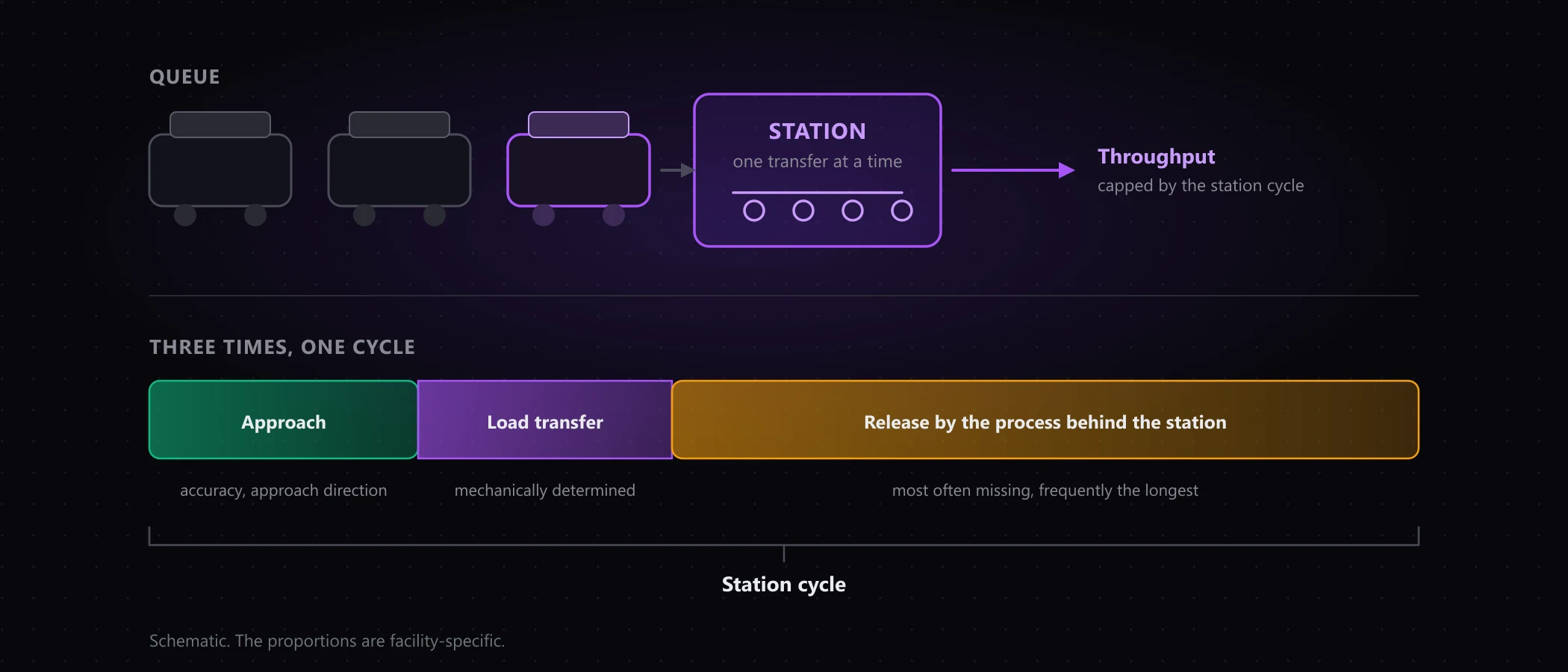
- Time at the station. Approach and positioning, the load transfer, and the release by the process behind the station. For a humanoid robot, the grasp takes the place of the mechanical transfer. Why this time is underestimated so often is covered in our article on handover stations.
- Charging. The trip to the charger, the wait there, the way back. Every robot charging during the peak hour is missing in exactly the hour the fleet was bought for.
- Traffic. The space a robot occupies in the aisle, and the encounters at intersections and bottlenecks. Beyond a certain point, every additional robot lowers throughput. That is the tipping point of the fleet.
The four inputs depend on each other. A robot that spends longer at the station lengthens the queue in the aisle, and a robot stuck in the queue charges later. That is why a spreadsheet rarely holds up, whatever the form factor.
What actually changes with a humanoid robot
The question stays the same, the values do not. A side-by-side view shows where the differences surface in planning:
| Mobile robot | Humanoid robot | |
|---|---|---|
| Load handling | picks up and sets down | grasps |
| Stations | designed for the robot: conveyor, lift table, rack position | workstations built for people |
| What decides station time | the mechanics of the transfer | the grasp |
| What needs clarifying before planning | station design and load carrier | which handling steps succeed reliably |
The table deliberately contains no performance figures. Speed, payload and runtime differ from model to model. The calculation takes the values of the specific model.
This also points to where humanoid robots make sense first. Mobile robots already cover long transport routes well. I see humanoid robots first where picking happens today: at workstations where something has to be grasped, which is exactly where mobile robots reach their limit. For sizing, this means the transport fleet is still measured by travel time and traffic, while the humanoid robot is measured mainly by its time at the workstation.
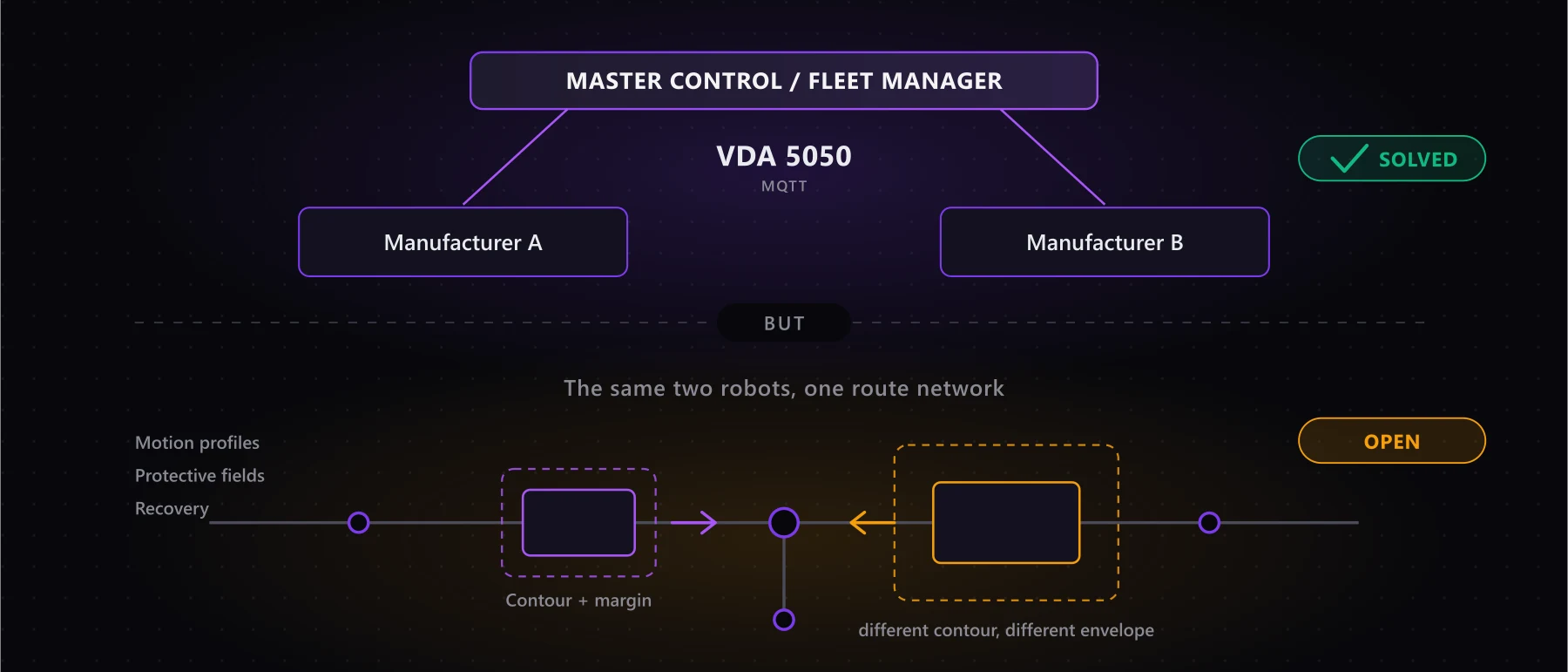
Where both work in the same facility, the result is a mixed fleet, with all the questions about contours, motion profiles and traffic that come with it. Dispatching in operation remains the job of your fleet management system. We complement it, we do not replace it.
Cost: price per robot times fleet size
The obvious question is what a humanoid robot costs compared to a mobile robot. There is no reliable answer yet. Manufacturers of humanoid robots built for warehouses generally publish no list prices, and mobile robots are almost always sold on request as well.
For planning, a different figure matters anyway. Published rental and service models charge per robot, as an hourly or monthly rate. The cost of a facility is therefore the price per robot times the number of robots, and that number depends on the same four inputs as above. On a monthly rate, a robot charging during the peak hour or waiting in the aisle costs exactly as much as one that is moving. A cheaper robot that needs longer at the workstation can therefore make the facility more expensive.
The same goes for charging. Several manufacturers of humanoid robots rely on battery swaps or short top-up charging for continuous operation. In the calculation, that is the same input as for a mobile robot: time in which it is not working.
Wait or plan now?
Layout decisions are made early and last long: routes and aisle widths, stations and buffers, charging infrastructure. They depend on the same four inputs, whichever robot ends up running on them. A humanoid robot does not make an aisle wider or the release in the process shorter.
If you plan now with a clean model, you lose nothing when a different form factor becomes available later. The same facility can be run with two robot types under the same peak load, and the comparison shows whether the new type works in that specific layout.
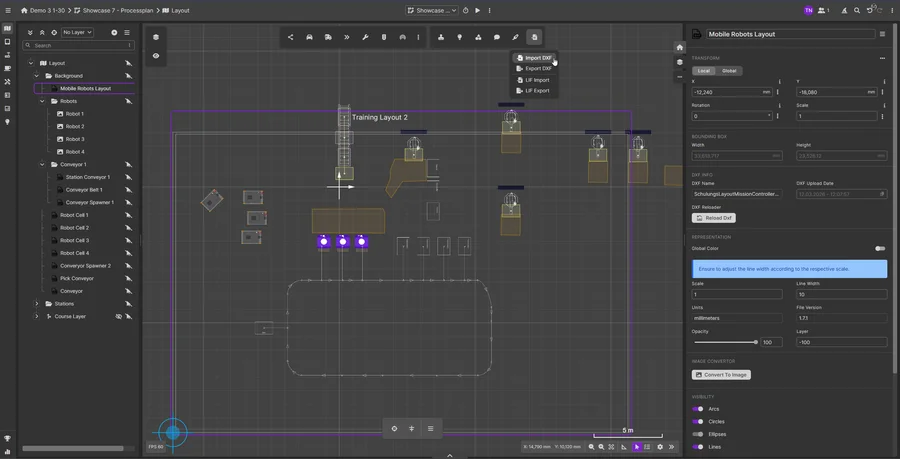
That comes with the boundary of our approach. We simulate on a graph, with nodes and edges based on LIF and corridors based on VDA 5050. We include a humanoid robot in this model when the manufacturer supplies the parameters: dimensions, speeds, time at the workstation and charging behaviour. It is then modelled like a mobile robot on defined routes between stations, which is also how we already model people and manual processes that share the routes with the fleet. A robot meant to navigate freely through the facility needs a different model, and we do not simulate that.
What this means for your next decision
- Form factor is an input to the same calculation. Travel time, station time, charging and traffic decide the fleet.
- The real difference is at the station. Grasping instead of picking up shifts where the time goes.
- The first sensible use is at the workstation. Where something has to be grasped, such as in picking.
- The values come from the specific model you actually plan to deploy.
- Layout decisions do not wait. A clean plan lets you compare a new form factor later in the same model.
If the question “mobile robots now or something else later” is on your table: a free initial call clarifies which inputs decide your fleet. How such a sizing works is described on our planning page. Get in touch.

About the author
Tim Nowak
Tim Nowak is co-founder and Managing Director of ScaliRo GmbH. He supports operators, manufacturers and integrators with vendor-independent planning and simulation of mobile robot fleets.
LinkedIn